Forty years in banking technology taught me that intelligence is only as good as the data it can trust.
Over the past year, I have met with financial institutions across multiple markets, and one conversation keeps returning. It is no longer primarily about AI budgets or which model to deploy. It is about the data underneath all of it.
The question in many boardrooms has shifted from, “How do we deploy AI?” to something more fundamental: “How do we redesign our enterprise data architecture so AI and autonomous agents can operate with trust, speed, and scale?”
That may sound like an incremental change. I do not believe it is.
In forty years of banking technology, it is one of the most consequential shifts I have seen. We are moving from systems that help people understand what is happening to systems that can interpret context, support decisions, and increasingly take action.
That changes the role of data architecture. It is no longer simply the foundation for reporting and analytics. It becomes part of the institution’s decision and execution infrastructure.
How We Got Here
I have watched this industry reinvent itself four times. Mobile-First brought banking to our fingertips. Digital-First reimagined customer journeys and operating models. AI-First enabled intelligence through personalization, automation, and predictive decision-making. Each wave solved a specific business problem and created significant value.
Now we are entering the era of Agentic Banking, where autonomous AI agents can reason, collaborate, make decisions, and carry out complex workflows across the banking value chain. We are moving from systems that produce insights to systems that can act. If you are leading a bank amid this transition, that distinction changes everything about how you build.
The Problem Nobody Solved Along the Way
Here is what I have seen across almost every institution I have worked with. The pace of innovation has consistently outstripped the evolution of the underlying enterprise data architecture.
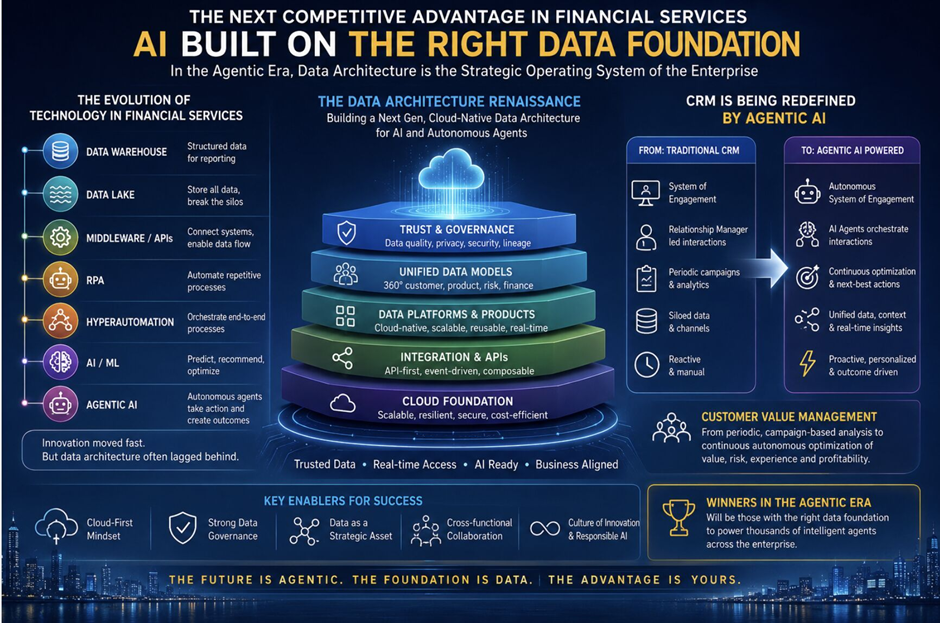
Data Warehouses gave way to Data Lakes, then Middleware, APIs, RPA, Hyperautomation, AI, and now Agentic AI. Each wave added capability. Yet, in many institutions, the underlying foundation did not evolve at the same pace.
Many institutions today find themselves with segmented data estates, duplicated customer information, inconsistent governance, and AI models that cannot consistently access trusted, real-time enterprise data. You can build the most sophisticated agent in the world. If it cannot access a trusted and current view of the customer, it may make confident decisions based on incomplete information. In high-stakes banking workflows, that can be more dangerous than keeping the decision under human control.
This is driving significant investment in cloud-native data platforms, real-time event-driven architectures, enterprise data products and data mesh principles, API-first integration, strong data governance and lineage, and unified customer and enterprise data models. In my view, this is becoming the most important technology investment of the decade.
From Systems of Record to Systems of Engagement
Another major shift is taking place in customer relationship management.
For nearly three decades, CRM platforms have served as the primary interface for sales, service, and customer management. In the Agentic AI era, that role is beginning to evolve. CRM is increasingly evolving into the system of record, while intelligent agents begin to take on a larger role as the system of engagement.
Instead of relationship managers manually identifying cross-sell opportunities, next-best actions, portfolio gaps, or customer service interventions, AI agents can continuously analyse customer behaviour, life events, risk, profitability, and intent, then recommend or orchestrate personalised actions in real time.
Customer Value Management is undergoing a similar transition. It is moving away from periodic, campaign-based analytics toward continuous optimisation, where intelligent agents can help balance customer experience, revenue growth, risk, pricing, and profitability.
But this shift depends on the quality of the underlying data. An agent cannot create a coherent customer experience if customer information is fragmented, definitions are inconsistent, or important signals are delayed. It also raises the bar for governance. Institutions will need clear accountability, decision boundaries, explainability, and appropriate human oversight as agents take on more consequential customer interactions.
The institutions that lead in the Agentic era will not necessarily be those with the largest AI budgets. They will be those that have built a trusted, cloud-native enterprise data foundation capable of supporting intelligent agents across the organisation.
In this environment, data architecture is no longer back-office infrastructure. It is becoming part of the enterprise’s decision and execution system.
The next competitive advantage will not come from AI alone. It will come from AI built on data that is trusted, connected, current, and governed.